
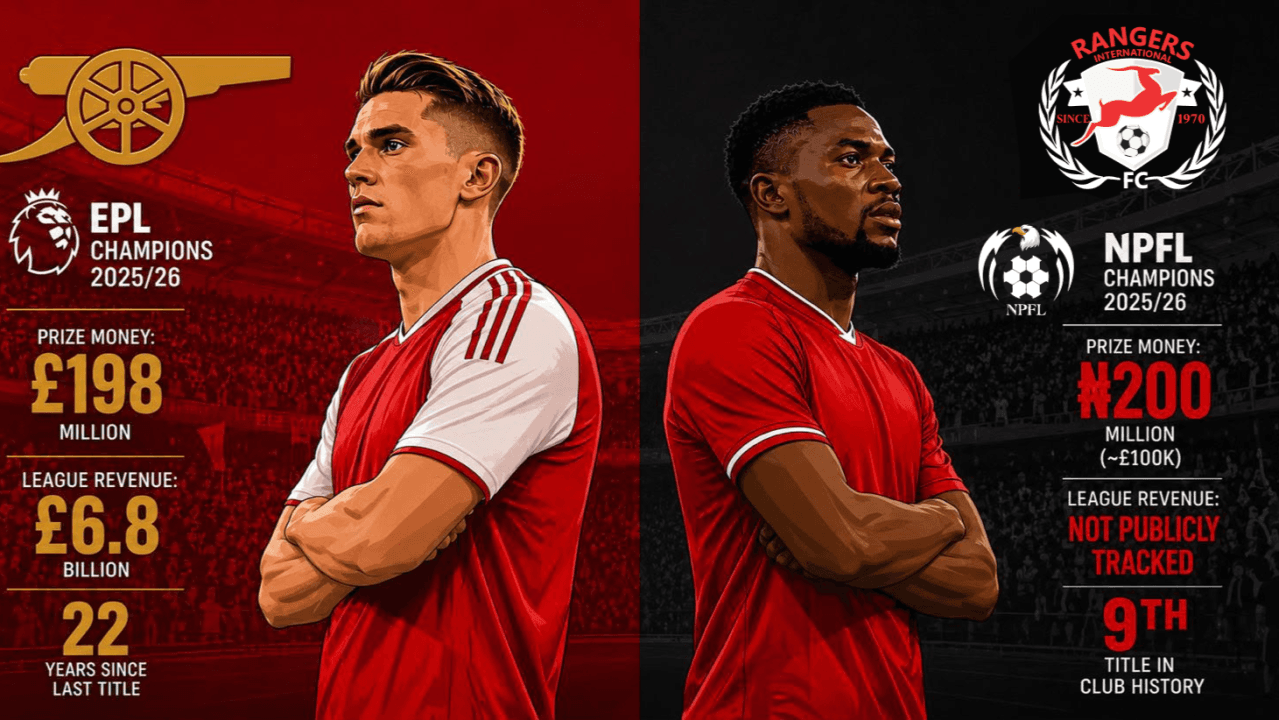
Arsenal won the EPL.... so what? Enugu Rangers won the NPFL too...
6/28/2026
On May 19th 2026 the whole world was red (yes the Mayor of New York wore an Arsenal-inspired "Jalabia" to the Eid celebration and the empire state building went red).
On May 19th 2026 the whole world was red (yes the Mayor of New York wore an Arsenal-inspired "Jalabia" to the Eid celebration and the empire state building went red).
Okay, I exaggerate. But we can't underestimate the amount of people celebrating the Arsenal EPL title win worldwide; and the viral celebrations all over Africa and especially in Nigeria. 22 years is a long wait. As a long-suffering Arsenal supporter myself I'm happy that the banter days are finally over and we can move from Trophy beer to a real trophy finally hahaha.
Now let's pause for a moment here and reflect on something I've been thinking about: the same week the whole of Nigeria was red and celebrating the Arsenal win, our own Enugu Rangers - nine-time champions, the Flying Antelopes - quietly lifted the Nigerian Premier Football League title on the final day with a victory in the last game. Sadly there were no trending hashtags. No matching colour posts. No viral posts on all the whatsapp groups or the Abuja gate lighting up with the colours (What are the Enugu Rangers colours again?) Most of us found out days later by accident and i am sure a lot of you are just finding out now 🙂
Both Clubs are champions of their land, both clubs lifted a trophy and a cheque is in the mail. Now let's see...
For the super-season they had, The Gunners walked away with roughly £198m in prize and broadcast money. Enugu Rangers got ₦200 Million - which is about £100,000 on a good day for the Naira. Now read that again and let it sink in slowly. Some accountants will treat this as a rounding error and it really means for every Naira Rangers earned for being the best team in Nigeria, Arsenal earned nearly 2000 for being the best team in England.
The most important thing here is that Arsenal's £198m prize is not a gift but just a slice of the revenue generated by the EPL from broadcast sponsorships and other revenues and even Burnley which finished rock bottom and was relegated still stands to earn over £100m. In contrast the ₦200m Rangers prize money is handed down by a league board and the players have to rely on the generosity of the Governor who has handed out ₦5m, a plot of land, a car and a house to each player and the club will still rely on handouts next season for funding. One number is institutional revenue from a product that has been patiently built and compounds season after season (The EPL made revenues of over £6.8b last year) and the other number from a poorly built product that isn't growing and largely relies on generosity and vibes.
What is the problem?
Now let's try to understand what the real problem is here. Is the problem talent? No Nigeria is blessed with football talent and you can confirm this by going to the end of your street and just watching a local 5 aside match, the EPL has over 20 Nigerians and Nigerian heritage players listed in the team list for this season and we have Nigerians playing football in Iran and other war-torn countries today for as little as $500 a month. The Arsenal side that was chasing the title has a lot of very familiar Nigerian names in their squad 🙂 Is it a lack of interest in our local football or footballers? No, the stadiums were full in the past. Kano Pillars still fill the stadium when they play a home game. Is the problem a lack of sponsors? The League had MTN, GLO and other big corporations bring some good money and Super Sport broadcast a good number of games through a massive broadcast sponsorship.
Our problem is the really boring concept of Administration. Let's explore how a football-mad country has ended up with a league worth a rounding error, two national stadiums that can't host the National team or just any football game, a Super Eagles team watching the World cup from home (helping to warm up teams actually going to the World cup 😡) and a handful of new stubborn private owners trying to build something real before they get frustrated out or swallowed by the system too. We follow the money and see how the EPL makes money and what it would take to close the gap that has very little to do with football itself.
Sports is Entertainment and Sports is Business and just like any other business you need to be selling a product people want to buy to generate revenues. Let's strip away the romance and explore where a club in the EPL generates revenues.
The Five Revenue Streams
Broadcast Rights. This is the largest source of revenue and forms the engine room for revenue. The more marketable the league is the more it can earn from TV rights. This also enables the league to earn revenues outside its geography. All those pre-season games all over the world and engagement with fan communities? Yes, that drives demand worldwide.
Commercial and Sponsorship. Shirt sponsors, Stadium naming rights, kit manufacturers.
Matchday Income. Ticket sales, Hospitality suites, Food and Beverage during games.
Merchandise. Shirts and the logos you see just about everywhere and even that shirt you bought online direct.
Player Trading. Buying young or developing through the academies and selling for profit (Brentford comes to mind here).
Others like UEFA tournaments (for those that qualify… Chelsea? 🙈) and Stadium utilization for concerts and other events.
Why does one product sell?
The EPL can sell its product because it is a meticulously packaged, legally protected and highly monetised Entertainment product. The EPL was built with very patient private capital that was willing to endure initial losses to build infrastructure and develop a product that has a big audience that can then be monetised. As with any business you must first develop a good product before you can monetise it for revenues and you must also continue to improve this product so your audience or subscribers do not churn. We don't have a product yet and that is why all the revenue streams are dry and this cannot be achieved through announcements and launches as there is no emotional connection to the buyers and any investor will only invest in a company with predictable, recurring, contractually-guaranteed revenue. Unfortunately when you look at a club in the NPFL, you see a team whose budget depends on which party won the last election, playing in a stadium it doesn't own, earning prize money that may not even arrive and when it does, cannot finance even player salaries in a league whose TV rights deal might not survive the season.
The talent is here, and the fans are here (a drive around some of the major cities last weekend and the red jerseys prove that) what's missing is the boring machinery underneath that keeps things running smoothly, the institutional stability that turns a beloved club into a business worth backing. In Nigeria most clubs are owned by the State Governments, they are run for political capital and are devoid of any long term planning and strategy for building a sustainable business model. The lack of commercial drive and understanding is why our stadiums are rotting and we fail to qualify for major tournaments and are now hooked to an imported product that will not create the local jobs or build the local economy.
It wasn't always this bad though
For the young people you might feel this is how it's always been. We lose the best players to Europe as soon as they can walk, empty stadiums, no fan connection to the clubs and this is the natural order of things. Absolutely not! In the 1970s and 80s the Nigerian league was a powerhouse with full stadiums and fans travelling across the country to watch their teams play. Leventis United, Abiola Babes, Iwuanyawu Nationale and Flash Flamingoes were some of the privately owned clubs who came into the league, raised the stakes, dominated and were successful. Leventis United pulled off promotion from the third division to the first division in successive seasons (sounds familiar? ;-) Wrexham has a whole Netflix story trying to do this). In 1986, coaches James Peters of Abiola babes, Wili Bazuaye of Iwuayanwu Nationale, Jossy Ladipo of Leventis and Charles Bassey of Flash Flamingos were speculated to be earning between ₦20,000 to ₦60,000 per annum (between 30 and 80 million Naira today). Abiola Babes signed James Peters as a coach on a ₦60,000 annual salary (81 Million Naira today), with a new Volkswagen Santana and accommodation before any bonuses, Players were earning ₦3,000 monthly before any match winning bonuses and often had cars given to them as part of the sign on package. Keep in mind that the Naira was at par with the Dollar then. This package for a player in today's Naira will be about (₦36,000 + House ₦1,000 + Car ₦3,000 = ₦40,000) ₦54 million before any bonuses. Nigerian clubs hire coaches from Brazil, Argentina, England and other countries and we had foreign talent in the Nigerian League.
Does this feel like you are reading the earlier sections of this article? A model with private clubs with investment in players, attracting international talent, etc. Ladies and gentlemen; my dear friends: we had the beginnings of a working model in the 80s.
Now this is where it gets crazy: these clubs did not fail because there was no talent, or because the fans stopped supporting the teams. They didn't fail because we stopped loving football, or because they ran out of money. They failed because those who ran the league refused to build something sustainable that would have commercialised the league and grow the revenues. The private owners wanted a professional league and when the administrators refused and wanted to keep all control, the private owners simply walked away. But by 1988 Chief Abiola, John Mastroudes, and Patrick Osakwe pulled off sponsorship for their clubs after a major disagreement with the NFA and subsequently disbanded the clubs. What happened? Could it not be resolved? By 1990 when the league turned professional (in name) the big money had left and the state government-funded clubs were left playing their games.
By the 2010s The league had a lifeline thrown at with some good money from sponsors like MTN with a four year N2.55Bn deal, GLO with a 3 year N1.8 billion deal and Super Sport with a massive broadcast deal reported at $34m over four years. The most important boxes had been checked - broadcast deal and title sponsorship deal. You would imagine it's all honky dori from here and the administrators would invest in the product and begin to invest and build a product that will have sponsors outbidding themselves and attract some more patient capital into club ownership, but we did what we do best - spend like the tap wouldn't stop flowing, plan for the short term and ignore all the problems that need fixing. We didn't fix the most important thing - The Product. So as it always happens the sponsors did not get any value and simply walked away without renewing. We are back to square one today, the league is announcing "big" numbers from sponsors (a N2 Billion Naira five-year sponsorship deal - $1.5 Million - side eye) the big question is what is being invested in building a product that will bring the passion out of people that brands will fight over themselves to be associated to in future?
Here we go… again!
There is some positive news though as some private money is back in the league with 4 out of the 20 clubs being privately owned. Remo Stars owned by Kunle Soname and Sporting Lagos owned by Paystack founder Shola Akindele are standout examples. These entrepreneurs, some from the tech and betting industries are trying again to bring their business knowledge and organization into the league and try to build businesses out of the football clubs. These clubs have also identified the challenges in the league (the broadcast revenue isn't coming soon unfortunately) and are focusing on player trading as their largest potential source of revenue (both entrepreneurs have either bought or taken majority shareholding in teams in Europe to provide a pathway for their players and also hedge against their investment in the Nigerian League). What these new clubs prove is that Nigerians can build serious professional forward-looking clubs with branding and fan culture that is already way ahead of the State-owned clubs. Interesting to see that Remo Stars went from winning the league in one season to being relegated the next season, I believe this just shows that the structure is broken and a few well run clubs cannot fix the system.
So where do we go from here?
First we need to fix the structure of our league and if we do not have a good product we cannot sell it and bring the proper revenues in to aid the growth. I am not saying we must adopt the EPL or the German Bundesliga model where the fans must control 51% of the club model but we need to put a commercial model that works together for our environment (some copying wouldn't hurt us here though). I would suggest the States can only own minority stakes in the clubs as this will reduce the influence of government changes on the affairs of the clubs and will allow for proper economics and long term planning for the clubs. Then we need to understand that Sports is Entertainment and this is Business. We need to approach it as we would appreciate every business idea and develop the product first before we try to pay dividends from the startup funding. There is a need for patient capital, building real institutions, protected by a government that only referees but does not own, the same way the CBN keeps our banking industry safe and thriving and allows the fintechs to innovate.
It's not too late to try again. Let's get the right structures and people into the league - A Nigerian just built one of the largest refineries in the world and is supplying aviation fuel to Europe, let's build our local league back.